Wireless PDA Tungsten W: yo in snuffbox

Here and waited - Palm OS 5.0 and the first computers based on the new operating system became a reality. Official presentation of Palm Tungsten T and Tungsten W had to hard for us, citizens of Russia, today. That's why the news a few themselves scarce, receded into the background ... Hopefully, we have experienced a nightmare will never happen again. And the news of the release of new computers will again be the main key ... the emergence of new Palm `s long-awaited and eagerly. Palm OS 5.0 originally was going to live down the list of "computer" events of the year ... Actually, on the balance of power on the PDA market fifth version of the Palm OS has affected even before its release (which, incidentally, and confirmed the significance of the event). On sale was a whole line of PDAs from Sony at very attractive prices. And recently we saw and the first family of cheap computers Pocket PC. Competitors are clearly preparing for the release of Tungsten. On the PDA market has become very crowded. However, the sensation, if any, expected with the advent of "home" machines based on Palm OS 5.0, has not happened. On the contrary, there is even some disappointment, because one of the new Palm `s - Tungsten W, which will be discussed in this review - running a modified Palm OS 4.1.1. What is it? Operating system so the cheese that programmers simply do not have time to finish patching holes? Or is it a conscious move - "otest" piece of cake at his Handspring communicators Treo, and then the vacated space to release a flock of new communicators under the brand name Palm? In any case - is unclear ...
Wireless PDA Tungsten W: yo in snuffbox
New Palm `s family Tungsten - are computers with color screens, high resolution 320x320 pixels which have already become standard for the handheld Sony. The backlight turns off a reflective, data entry, touch. In the older Tungsten T models use a new processor family of ARM processor with a clock frequency of 144 megahertz (expected seems to be 175). In proprietary specifications indicated processor model - Texas Instruments OMAP 1510. Innovations, and hardware and software, pretty much. To equip the Palm is getting closer to the family of computers Pocket PC. This means that the handheld machines are becoming a universal tool for "all occasions" and become completely previously unknown qualities, such as wireless LAN terminal. For older iPaq models with integrated Bluetooth module is no longer news. But that just like that, en masse, claiming to be the industry standard - it should agree that something ... soon, very soon, Bluetooth (and, presumably, competing with wireless adapters) will become mandatory membership of any PDA - if producers wish to commercial success their computers. It also is about the massive family handheld machines, rather than the rare exotics. Bluetooth module integrated into both new models Tungsten, as, indeed, and infrared communications port and Universal Connector (for connecting different peripherals and synchronization cable), and a slot for flash memory cards SD / MMC. And in a model of T (improved by the application of the new operating system), and in the model W in some way to change the organization of internal memory and Palm `. The amount of memory declared in 16 megabytes, but there comes a clause that user data is allocated only 14 MB. I wonder ... And it's not all. The presence of all computers built-in microphone and headphone jacks mean multimedia orientation of new Palm `s. The fact that we waited so long, it becomes a reality - Palm `s learned to" sing "(alas, is fully valid only for the Tungsten T). As well as recording sound and serve as a digital voice recorder. Very interesting design of the case seemed to me Palm Tungsten T. The first and most significant - the case folding. The lower part is shifted vertically in the closed position concealing the region Graffiti. This reduces the "hiking" the size of a computer due to under-utilized in the normal conditions of the machine. As a result, Tungsten T can be called one of the most compact handheld computers from all presently released.
Wireless PDA Tungsten W: yo in snuffbox
Senior Model Tungsten T
Another innovation - the application instead of the usual five-way navigation keys large navigation buttons. Approximately the same button-joystick is used in computers and Pocket PC, it should be noted, fully justified. With regard to software innovations, it is, above all, the operating system itself in the Tungsten T. Evaluate all of its dignity, we still have. In the meantime, I note that the main indicators Palm OS 5.0 is much closer to its predecessor, Palm OS 4.1, than for Windows CE. That is, no special multimedia heights wait still do not have to - is unlikely we will get something more than we have been in the Pocket PC (all the same processor at the Tungsten T is not so hot what a rocket). Another thing - what we generally expect from Palm OS 5.0? CPU power, enough for trouble-free decoding MPEG4 - but this still is not known. Effective work with MP3, so with the help of Palm `and you can listen to music - it can and typewriter Sony, working with the previous version of the operating system. Functions of the wireless communicator ... Here maker Palm, and really made a real breakthrough. From now on any computer Tungsten can be paired with a cell phone having a built-in or externally attached module Bluetooth. It seems that the scope of the CCP is expanding. Small machine has outgrown the stage of an optional digital toys.

The second player - Tungsten W

Palm Tungsten T - is a "large caliber" because it is the model T is designed to attract the attention of potential buyers, enacting agony of choosing between Sony multimedia computers and typewriters conservative handheld Palm. It is clear that many interested users tend toward the Palm `but at least because the original looks like any respectable, even the most perfect, but - repeat ... It kinda purpose of the second model Tungsten W, presented almost simultaneously with the model T.
Wireless PDA Tungsten W: yo in snuffbox
Wireless Tungsten W
At first glance at this little masterpiece arises sudden thought - we see a color Treo! Computers competitors are very similar not only in appearance but also in many respects. They, in particular, used a modification (a Tungsten W, of course, newer), the previous version of Palm OS. And it is very strange - all waiting for Palm's new models with the new operating system. There is even some confusion - the same name, model, Tungsten, a very similar look and feel of your furnishing, and suddenly a different program filling.
Wireless PDA Tungsten W: yo in snuffbox
This Treo 270: Spot the difference!
True, the situation with the Tungsten W is still unclear. The company about the operating system that is installed in the model W, silent. Kin-Palm `the site has information about what this machine is released for a special (telephone?) Edition of the old Palm OS - version 4.1.1. But as there was no certainty and no. Have to wait several days - until any official information or the first practical reviews of new computers. What attracts you to the Tungsten W in the first place? Very neat and even handsome building device. All previous models of Palm special design refinements do not shine. Well, except that the Palm m500 was isolated from the total mass of an elegant metal body with a thin, razor-silhouette ... Tungsten W stands. And how stands out! Circular antenna (for anything not hooked), rounded shape.The screen seems small, but this impression may be misleading. Below the screen is located button keypad. It is designed for typing in "hiking" conditions and replaces the system of handwriting Graffiti. Good or not such replacement - is unknown. But for the communicator, and yes even at work when connected to the Internet mode, a fast guaranteed correct typing more important than a leisurely convenience handwriting. Keypad buttons are made flat. If we compare with the Sony CLIE NR-70, in which the keypad buttons have a deeper, does not look so convincing - buttons not to press the stylus. But, again, a final assessment can be given only after practical tests. All is not gold that glitters ... With the older model Tungsten T to W moved buttons running basic applications (their shape altered) and the Five-way navigation button joystick. In this case, the joystick is placed at the edge of the shell, and this, in our experience the use of certain computers Pocket PC, not very convenient - when you press the button, the communicator will try to slip out of hands (tight hold on the typewriter ... the driver). Most controversially, in my opinion, the solution - transfer slots for flash cards Secure Digital memory on the right side face of the housing. The model T slot installed on the upper side - next to the pen and the infrared window. In the model of W, in which the upper edge is even and a jack for a headset and antenna location for the slot was not found.
Wireless PDA Tungsten W: yo in snuffbox
Slot on the side of the hull is not very handy thing. Know this from experience with the Palm m125. Card memory clings to the edge of the cover, trying to jump out of the nest when the machine is in the pocket. And the finger when machine to rest in his hands, falls exactly on the card - that and look casually nazhmesh (memory card is retained in the slot inside the latch). In the Tungsten W, while holding his right hand, the slot will have the base of the thumb. To press the memory card and, thus, lose it, will require considerable flexibility in the hand ... But anyway - better to be at the top of the card as a series of typewriters 5xx. Tungsten W technical specifications are almost identical to the specifications of the Model T, with one very significant difference - a device installed an old Motorola Dragonball VZ processor clock speed of 33 megahertz. And that means ... goodbye video and MP3. Well, except that the module will release the external (a new external keyboard is presented in conjunction with computers). In the device nominally integrated Bluetooth and tri-band GSM. The most "sweet" - supports the protocol GPRS. That is, in Russia (in any case - in Moscow) Tungsten W is guaranteed to work as a cell phone, and as a device for data transfer. With such a device can be safely transferred to him all e-mail (if its not too much). And the web to leave a "big brother" - a personal computer.
Wireless PDA Tungsten W: yo in snuffbox
Finally - about nutrition. As always, Palm is for this part of the champion. Manufacturer claimed 10 hours of work and 250 hours standby time from svezhezaryazhennogo battery. Agree, very nice figure, even by the standards of cost-effective mobile phones, which typically do not trigger a toy, do not read books, do not write letters ...

A few words after

What can be seen in press releases and the first still timid and careful review of the new Palm `s, I tried to discern. I know for sure - even the controversial decisions that are applied to computers, family Tungsten, will soon become the accepted standard. Yet Palm has been and remains a trendsetter in the field of PDAs. Another question - how long it will last. When we wait for Tungsten T and W, we have in Russia? I think in the very near future.Tungsten W will be distributed through mobile operators, is tentatively priced at $ 549. However, none of the operators does not offer a machine, even on reservations. The prices for our sellers, of course, initially will be considerable, but the situation today, when the Palm at the same time produces a whole line of cheap, moderately expensive and very expensive computers - namely, Zire, PC series m1xx, m5xx and these Tungsten - is unique. We can choose any model of their own wallets and requests. It seems that such freemen users Palm `s not yet been ... The authors, translation:

Laugh satire in the chain of Orion. Review Game "Orions: Legends of Wizard&quot

"West is West and East is East.

And they do not come together ever

While Earth and Sky do not mess up God

The day of his Court.

But there is no East and West -

They will merge into one,

When we consider two mage each other's eyes,

Toshiba e330/e335: up the stairs leading down

The most convincing evidence of the rapid development of technology - the rapid decline in retail prices. If we follow this statement, it turns out that PDAs are developing at unprecedented pace. In the past five or six years the cost of the CCP has remained more or less stagnated. Six months ago, we knew we had a budget computer - a machine worth 140-200 dollars. "The middle class is" occupied a niche of 200-400 dollars. The most advanced handheld cost from $ 450 and above. But today the situation has radically changed. Expensive cars almost never cheaper, but the price of computers average slipping to around $ 200, a simple, entry-level PDAs are cheaper than the hundreds. We in Russia to lower prices for handheld computers have not yet is of such a landslide in nature, as in the west. Still remember the specifics - we do not manufacture computers (with a few exceptions, but here we are talking only about the assembly of prefabricated components), our customs policy influx of cheap equipment is not conducive, and suppliers of computers from abroad still need to something to exist. That's when the capacity of the Russian PDA market will increase to values ​​comparable with the desktop market, when in this area will rush to all and sundry, then the difference in prices between Russia and foreign countries will not be so great ... on the PDA market a family of Pocket PC the next event. Began commercial sales of PDA Toshiba e330 and e335, submitted in September. New Toshiba replenished a very young group of low cost handheld machines, in terms of functionality nearly as "adult" models. Almost - because some simplification is still there. About them and talk. I wonder the same - what has been reported (thank God, not the principles) to the buyer of portable computing, if he chooses a cheap handheld computer. By the way, interested in receiving cards. Dear CCP have not yet become branding techniques (we do not have a lot of people who are able to distinguish the eye from a portable handheld gaming console or any calculator and compare this situation with the social position of the holder of the CCP), but faced with competition from fellow budget . What motives should guide a person spends on a PDA is almost twice as much money than they could spend on low-cost model? .. We speak, of course, about Russia - in Europe and America, the situation is somewhat different. There and then the car-no surprise. Moreover, a good car.

Purse, wallet purse ... What?

Looking closely to the e330 and e335, having read the descriptions and reviews (live machines at my disposal, as it normally is not), I come to the conclusion - the most ordinary computers. But most importantly, what is required of a handheld computer - the reliability and high degree of compatibility with existing software. Everything else, including the futuristic design is secondary. In addition, laptop unusual forms, as a rule, terribly inconvenient in practical application. I, for instance, is simply not enough "swing hand" in order to comfortably hold the iPaq. Widish it for my hands - just a little, but still. In this case, declare that I have "no mining arm," I will not. My hands were just miners, in the most literal sense. (Six years in a heroic profession underground miner - whether to have any further evidence?)
Toshiba e330/e335: up the stairs leading down
So, e330 and e335 look quite casually, but that does not mean that in their tiny interiors are no new solutions. The first - on computers used budget option most productive to date, "pocket-computer" processor Intel XScale PXA250. In contrast to the more "high-velocity (and the standard today for the new Pocket PC) processor, this option is reduced clock speed - from 400 to 300 megahertz. This is a basic compromise that had to go to the developers to reduce the cost of the CCP. How much smaller CPU clock speed affects the performance of the system as a whole? Today, almost no effect, but tomorrow the difference in performance will be quite obvious.The fact that the present application for Pocket PC is optimized for the ARM and XScale processor computing resources are not used in full. There will be new programs (already there) for the same new computer, will appear and the possibility of practical comparison. We only note that to play MP3 music files and video in MPEG4 (the most demanding tasks for the Pocket PC) processor with such a frequency of 300 megahertz is enough for the eyes. The second compromise in the way of cheapening the computer has been implemented yet in the previous model Toshiba e310. This rejection of any hardware wireless communications ... and again - small compromise, because until recently no one handheld computer had no built-in Bluetooth or Wi-Fi, or module GSM. Even today, the same Bluetooth installed only in the most expensive models are so expensive that you start to think about the appropriateness of such expenditures. Separate adapter card in the format of flash memory, plus the computer itself are cheaper than a computer with a built-radio - not much, but quite a significant amount. Compromise the third - a simple and easy constructive, in which "packaged" electronic filling machine. Housing and really easy to shape and made of plastic. On the other hand, the use of plastic in handheld computers is well justified. Lighter weight material allows us to make the shell wall thickness, which increases the rigidity of the structure. Appears and is not immediately apparent quality, such as resistance to scratching the surface of PDA. Most of all recurring scratches annoy the owners of "aluminum" typewriters Sony (for example, T-Series). Outwardly, these computers look great. However, they should be kept exclusively in cases with a soft inner liner. Metal side machines do not like contact with an ordinary pocket detail - the keys, lighters, ochechnikami. Surface of the body is covered with cobweb scratches and quickly loses its marketability. On the plastic surface of the body of my Casio BE-300 for almost ten months of intensive use (and, not under glass) is not a single trace. Not one scratch, no dents. Perhaps the aluminum material is great, but for the Pocket PC will fit perfectly, and plastic - high quality and, if possible, unpainted. Unfortunately, in recent years manufacturers PDAs tend exactly to the color of the plastic in bright, eye-catching colors. Not only that, at such a difficult machine to work (a bright color of the case simply annoying), so the paint still oblezet like domestic Avtoagregat "Zhiguli" ... C bundling everything as usual. File Type Toshiba site that the user finds the box, in addition to the device itself, and even USB-"crib", charging cable and a set of software. As for compatibility with various accessories and peripherals like folding keyboards, compact digital camera and Bluetooth cards, the complete list of previously tested on the subject device to be found in the Toshiba e330 in the manufacturer's website. Now the trade-offs that developers e330 and e335 have been avoided. Speech on the amount of memory installed, sound capabilities, built-in battery capacity, display. The memory requirements are compared with the model e310 doubled and amounts to 64 megabytes. Permanent memory (of course, a rewritable flash) 32 megabytes. Which of your computer or invent, and 64 megabytes of memory will still be enough. Except for the use of machines as a MP3 player and even more so the video player. In this case, 64 megabytes is enough just "to try", but for more substantial work will have to purchase flash memory card, good in computers installed slot SD / MMC (without any kind "jackets"). A year ago, it was possible shook his head, but today it does not cause absolutely no emotion as the Secure Digital format had become the accepted standard for most manufacturers of PDAs. On the sound. This new computers are no different from other Pocket PC - has a built-in speaker and, accordingly, the possibility of using the PDA as a multimedia handheld console. No only built-in microphone, but there is jack for an external.It is clear that without a microphone it impossible to implement the digital recorder that does not interfere to find a good program from mikrofonchik and recording on the side. On the battery e330 and e335 can not say anything nor bad nor good. It is unlikely that the new Toshiba will be the champions of battery life (otherwise the firm would be praised to the skies this particular feature of its KPK), but the technique of this worthy manufacturer that laptops, handheld computers that "hungry syncope" has never suffered. Capacity lithium battery, 1000 mAh should last for 7-8 hours with the backlight turned off (my reckoning, but no official information). By the way, the screen ... The press release referred to the manufacturer color active matrix LCD - the company NEC. The screen is built on the already familiar transflective technology - with dims. Size - Traditional 3.5 inches diagonally. That is quite worthy features that Toshiba is always justified ... And what, in fact, differ e330 and e335? Absolutely nothing. This two twins who do not have any positive iron differences. E330 model aimed at the corporate market and is equipped with only the most necessary software. Model e335 is designed for consumers and is supplied with a set of entertainment and multimedia software ... Mindful of the habits of producers to invest in a box of computer disks with all the software crap, I think that should be buying Toshiba e330 - when the machines will appear in Russia, of course. Frankly, I'm lack of clear differences between the models at their absolute similarity of the hardware is somewhat surprising. Obtained as in the post-perestroika Russia. Were you at the head office basement, put the Secretary fax - already the company president.

Small lyrical afterword

What happens next? And then we should expect when the new computers will reach us. And closely monitor the dynamics of price changes on the e330 and e335 in Russian stores. Once the first excitement (Toshiba for us has always been more than just a computer) to diminish, the price is sensitive poulyagutsya, then be run to the bank withdraw a money ... However, this recommendation does not make sense. Pocket PC is chosen not by some criteria. Little car must see and want. And then all of megahertz and megabytes overshadowed. It remains only a dream, sweet delusive dream ... We feel that a PDA most miraculously change our lives to the limit condense and organize, convert minutes to hours of tedious inactivity unforgettable pleasure ... The authors, translation:

Computex 2005: four pavilions news. Part II

Information in the ear, or a small memory shustraya

"At the moment, I - the only one happy owner of this jewelry," - smiled, marketing manager at Pretec Ingrid Wu, removing an elegant earring and inserting it into the USB-connector on your computer. "This is our presentation of" - she explained.
Computex 2005: four pavilions news. Part II
That same shackle ...
Companies Pretec, the author of more than one hundred patents in the field of memory cards and USB-drives, the developer of the famous standard memory cards CompactI / O, also known as CF, and the manufacturer of the smallest USB-drives of 2003, along with Intel-ohm was isolated a separate room that looked more like a boutique rather than a demonstration space technology company. All the left wing was covered with booths, upholstered in black velvet and painted them a variety of elegant ornaments and accessories - tie pins, key rings and pens ... All accessories are made on the basis of the new standard CU-Flash, the company has demonstrated in January at the International Consumer Electronics Show 2005. Drives made by this standard, fully compatible with USB, but substantially different in design from its predecessors, having a size of ten (!) Times smaller: storage size of the standard (21 x 1.9 x 1.9 mm) make them very similar to the SD card and RS-MMC. For comparison: it is considered so far camym miniature drive iDisk Tiny from Pretec, has size 32 x 13.5 x 4.5 mm (about these devices, see below).
Computex 2005: four pavilions news. Part II
Those same USB necklace ...
With their small size, they maintain the highest market rate of data transfer - read 166H (24.9 MB / s) and 80X for recording (12 Mb / s). In the production of a patented Pretec auto technology, the cost of these drives can be as low as $ 6 - a figure that will force many manufacturers start. "We tried to present a new concept, in which the USB technology is transformed into an accessory - explains Ingrid. - Unfortunately, our sales channels do not correspond to this format, so before the show we have not yet made a final decision about whether to go for sale accessories with our trademark. However, at the Computex products interested in a number of distributors, so I guess, on completion of the exhibition, we again discuss this matter with our management. At the moment I can say with certainty that in the second quarter of this year will go on sale pens CU-Flash ". In the same period, according to the Distribution of a press release, are expected to appear normal CU-Flash cards with memory capacity from 16MB to 1GB. According to customers' requests, the cards can be equipped with an authorization for access to information, protection of the recording and automatic start.
Computex 2005: four pavilions news. Part II
Handle with CU-Flash drives go on sale in June
Part II "width =" 400 "height =" 272 "/>
On the timing of the release of this elegant tie clips yet unknown
CU-Flash cards are now candidates for the PDA, which will significantly increase the chances of memory: the same Pretec has released a series of USB drives iDiskII capacity 32MB, 4GB, and here at Computex 2005 was also presented iDiskII 8GB, announced earlier but have not yet gone on sale. Like other drives in this series, iDiskII will be released with pre-mail client FlashMail, as well as security and MobileLock SecretZip. Mobile Lock will configure the computer so that it will only work when inserted in the USB-connector iDiskII, and SecretZip protect your files and archives with a password. According to customer's device can also be mounted module Bluetooth. Read / write drive is 16MB / s and 12Mb / s, respectively. Developers also promise to iDisk II 166x, which will provide speed to 25MB / s read and 12 MB / s on record - a record the options that were first presented by the example of iDisk Tiny 166x, showcased here. Cool? Of course, great. Such records! Such volumes! Such speed! And now the cold water: expected price of the device, which will appear soon, is 999 U.S. dollars.
Computex 2005: four pavilions news. Part II
All the champions in pedestale Honor
Despite the fact that the iDisk Tiny 166x, mentioned above, was introduced in January, he had not yet gone on sale, and proudly showed off the stand as a novelty. It is USB-drives iDisk Tiny series have been awarded the magazine "Time" award "the best device in 2003" (Best Gadget 2003). Also in progress drives this series was attended by such giants as Nokia, Alcatel, Yahoo, Visa, OKWAP, Mitac, Micron and others. Good news: in the second half of this year are expected to appear iDisk Tiny 266x, which means even greater speeds of up to 39.9Mb / s and 19.9Mb / s read and write, respectively. About the price, unfortunately, no information yet. Among the USB drives on the stand were also represented in his time flashed on the news unusual "indicator Ghost" (Ghost radar) and "USB-land": it turned out that both devices are released in Japan by Solid Alliance, used the stuffing from Pretec. Funny drives, filled in the form of land became the most popular in Japan, but to the indicator of ghosts in Solid Alliance seriously. "It's not a toy, it - the meter" - said during the release of a model vice president Yuichiro Saito. Recall that according to the description, the light begins to glow when it detects "unusual magnetic fields", which many viewed as a direct indication of paranormal activity. Judging by the color, showroom Pretec citizens from the other world to this day have not visited. "Anyone spotted during this time? - I asked for Ingrid." Oh, yes! To my horror indicator works in my office. We measured even when the equipment off and on, but stubbornly indicator is lit, so that the return to the office is always a little scary. "That's how. But some scary do not want to go to work and without any indicator ...
Computex 2005: four pavilions news. Part II
Indicator ghosts
Part II "width =" 500 "height =" 242 "/>
USB-land
And, finally, map the standard Secure Digital (SD) with a new high-speed interface, presented earlier, but so far the market has been received. Works on technology "Dual Channel" is based on a 16-bit bus architecture that provides the speed 133x (20MB / s), which exceeds more than twice the rate of the previous generation (the 60s, 9Mb / s). On the stand were presented cards with 256MB, 512MB and 1GB (soon also pledged to 2GB). Unfortunately, no information about the price again unavailable.
Computex 2005: four pavilions news. Part II
New speed SD. Very soon.
Features a new series of SD memory card from Pretec:

Adventures Palm in Russia

Adventures Palm in Russia
We are accustomed to the fact that most technical innovations comes to us very late. The phrase "began selling in Japan and the U.S." most often means that the device in question, if and will appear in Russia, the best month in three or four. And then do not reach Moscow. Recently, however, the situation began to change for the better. Nokia shows new items on the same days as the world, ViewSonic brings the most "fresh" tablets and wireless monitors. Today appreciated the Russian market, and Palm, Inc. - New models show in Moscow two weeks after the world premiere. A shipment of large quantities of new PDAs in Russia began a week ago. So, on Tuesday in Moscow hosted a presentation of new models of the global market leader CCP, the company Palm, Inc. In many respects, noisy premieres around the world and the need to position delivers the Palm was able to maintain this leadership. Presentation, due to the lack of representation in Russia, Palm, organized a group of companies "White Wind".
Adventures Palm in Russia
Palm is of interest
Most probably, great news - not the appearance of new devices as such, and the birth of a new concept of the world's largest provider of handheld computers. First Palm homogeneous products will be clearly divided into two categories: cheap, "youth" products and devices business-class, top-model for wealthy business people. Zire and Tungsten - not just refer to specific machines, and the names of series devices - Zire cheap, Tungsten - expensive. Diversification of products should also help Palm, Inc. strengthen the shaky position in the market and attract new customers. Moreover, according to the company, these buyers will be set.
Adventures Palm in Russia
Zire
Zire has become a truly mass product, and on an unprecedented scale to this. Its like a calculator and "Tamagotchi" will be sold in supermarkets and shopping centers almost as a souvenir, trinket, in a transparent plastic bag, to housewives, going for groceries, were able to buy a typewriter nephew as a Christmas gift. Fortunately, the European and American standards Zire is worth mere pennies - $ 99 U.S.. Zire will not even advertise in a special way. There will be serious and solid rollers and posters for mobile professionals, the target audience Zire - teenagers, students and other young people, women, and generally people away from the computer. Obviously, the Zire line will bring the company's money was due to quantitative sales. Whatever the cost of the device, it is obvious that at a price of $ 100 (in Russia approximately $ 120-130) the sale of each machine to bring big profits will not. Well, never mind. Palm will take a number. Tungsten T - is another matter. This is an objective way PDA, designed for those who prefer high-end. It contains technical innovations that have and will become the main "article" appeal - a new operating system, the new multimedia capabilities, the new processor, new navigation system, the new wireless features, the new screen quality, the new software. No one can stand against such a flow of novelty! For which, naturally, has to pay. Machine will cost five to six times more unpretentious Zire. So, first on the hands in the audience went to Palm Zire - in my opinion, the world's first PDA in a milky-white body. While Zire passes from hand to hand, it seems that you now give the most naidesheveyshuyu Chinese "soap-box" (actually, a model car in this country).However, the tactile sensation is much more favorably. Plastic pretty tight and pleasant to the touch, although the rear wall in my fingers still creaked. China ... Otherwise, the typical Palm Operating System 4.1 - the usual applications, familiar interface. Is that the front-panel buttons smaller (left button to display the diary and address book). Even infrared is preserved (a stone in the garden Casio BE-300)! Rather svetlenky 160x160 monochrome screen is closed lid of a dense rubber. To avoid scratches. More after the two-minute dialogue is hard to tell, but overall a pleasant experience. Very much nice polished white body - would look great in a blister pack and attract customers. Palm will even be giving away specialty retailer stands at 60 machines each, where the Zire will hang like bags of frozen vegetables. All for a beginner! This package will help the potential buyer feel how light and compact machine. Zire weighs 109 grams and pulls his shirt pocket any more than any of today's cell phones.
Adventures Palm in Russia
Zire and Mitac Mio
Another innovation - a battery instead of batteries in entry-level models. Perhaps, given how many "live" without charging black and white Palm'y it's great. The only thing that directly causes depression, so it is 2 Mbytes of RAM. In fact, at least 6 extra MB for each PDA is not worth to Palm, given the volume of purchases, almost nothing. A user would mean a lot. With the 2 MB read no books, no items can deliver ... Sorry. On the other hand, a gift for New Year! Sales, however, the novelty should appear considerably earlier. According to Simone Hosack (Simona Hosek), manager of Palm's sales in Eastern Europe, Zire for a week like go to Russia and on the counters appear in the next few days. However, she admits that Zire - not quite a Russian product. We have the PDA market is not yet sufficiently massive, that grandma bought a handheld computer for his granddaughter at the grocery store. Therefore, the Palm does not place much hope on the Zire sales in Russia (and, respectively, in "The Seventh Continent," we hardly see these PDAs). But another model, Tungsten T, perfectly suited for our market, where everyone loves an expensive and beautiful.
Adventures Palm in Russia
Tungsten
When you take the first Tungsten T in hand, I want to immediately turn it into a beautiful paper and give the woman one loves. Sleek, tiny, but at the same time solid and some "reliable" box very comfortably in the hand, gently illuminating the neighborhood light display. However, soon it turns out that the "soft" - this is temporary. If you include backlit "full", Tungsten T completely replace the heart in his hand Danko. Such illumination I have not seen on any Pocket PC. Although ... Subjective feeling, but I display HP iPaq 3900 still like more. Perhaps another reason that the maximum level of illumination Tungsten T amiss, and to find a black cat in a dark room, even in its absence there - so clearly not necessary, but eats batteries. But it looks just great. Cool metal casing with a clear course of the bottom panel is almost puppy dog ​​enthusiasm. Want to sit and open-closed area of ​​graffiti. Silk-click! Metal gives confidence and solidity, but this adds to weight. Tiny PDA, probably a third less than the average Pocket PC, very weighty - 157 grams. However, if you do not know that before you Palm, at first it seems that in the hands of the Pocket PC. It's funny, but Palm as one of the main advantages of the new Tungsten T five-way joystick puts that on Pocket PC (even if Windows CE 2.11), appeared just in prehistoric times. Thus, in the hands of the machine with a bright color screen with a joystick to play it a video ...Pocket PC, the real! Indeed, the new Tungsten T is very effectively leverages the new processor Texas Instruments OMAP 1510 (140 MHz) and a new operating system - Palm OS 5. Still, the main thing that distinguishes the Tungsten from its predecessors - is no joystick, no Bluetooth, and multimedia. Video plays as the best examples of XScale Pocket PC - Trailer film "XXX" just "flew", posing in front of about 15-17 frames per second, the recorder records the audio sounds. Feast on the street Palm! Holiday, unfortunately, strongly commends subbotnik. Applications for video and MP3 on Tungsten there. They need to acquire (for a fee, of course!) From third party (eg, Kinoma). However, considering the number of ... "Not quite legal" sites with software for Palm, it can be assumed that those who do not want to pay, pay will not. Compared with version 4.1, Palm OS 5 (at least on the Tungsten), significantly expanded set of integrated programs. In addition to the usual - Diary, Address Book, To-do list, notepad, notes - came here: the utility for sending SMS, E-Mail or dial directly from your address book, voice recorder, photo viewer, something like "learning tour" of the CCP. And found quite a decent set of "wireless" applications: VersaMail - email client with support for multiple accounts and exchange of attachments, the client sending SMS, very advanced web-Brauer, client AvantGo, wap-browser, dialer, and two utility for working with Bluetooth. One - a wireless chat, the second - a virtual "easel" in which users can run four Tungsten'ov simultaneously.
Adventures Palm in Russia
Bluetooth in Action
Of course, not to be unfounded, we must thoroughly examine and test the new Palm OS 5 on, but at first glance - a very attractive device. Questions - not too little is 16 MB RAM (although, probably, if the expansion slot SD / MMC - is enough), but may "stretch" batteries (Simon Hosack said that five or six hours, and even if so, for self-respecting Palm'a a few!) why it is so expensive (approximately $ 550)? Nevertheless, the machine is very cool looking, works well, and will certainly sell well. Especially if the top sales will be supported by competent advertising company. And here is how everything will be fine - the big question. Throughout the world, Palm gradually ceded its position Microsoft with its Pocket PC. Issue PDAs to Palm OS 5 and the new cheaper model - one of the few remaining companies have chances to regain his confidence and market position. If the new products will be not too successful, Microsoft will eat just the market, while Palm will take on the position of the CCP for enthusiasts. In Russia, the situation for Palm generally catastrophic. In effect, probably some national contexts, we have more like Windows CE (Pocket PC in the history of Russia begins with this platform, not the Palm OS, as all over the world). Therefore, the Russian market has already outstripped the world trend - Pocket PC, Russians are buying more than Palm OS. Loud presentation involving multiple members of the media - a chance to win the position for the Palm. But this is a topic for another thought, the results of which will be published shortly on HPCru. And I would have bought a Tungsten. Beautiful. The authors, translation:

I-tech Bluetooth Virtual Keyboard: Science Fiction at your desk

I confess that familiarity with Bluetooth Virtual Keyboard from i-tech (or short-VKB), which took place earlier this year, risks overshadow all other events to be held at the PDA market in the foreseeable future. Before us - an elegant solution to the problem of text entry, a unique accessory for all mobile devices, and most importantly - absolutely fantastic to use a toy. Acquainted with it in more detail.
I-tech Bluetooth Virtual Keyboard: Science Fiction at your desk
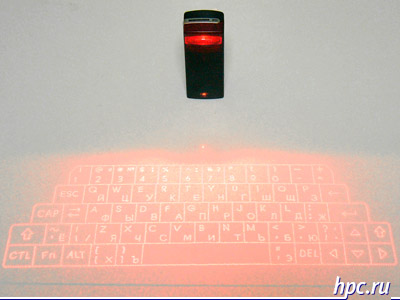
Photos do not reflect the actual brightness of the VKB
By the way, pictures do not reflect the actual brightness of the virtual keyboard. In fact, the projected image - bright red, high-contrast, well-read, so to distinguish between keys without problems. Well, yes it costs photographic equipment, and we return to our review. Today, perhaps, no longer need to convince anyone that to work with the browser, ICQ and e-mail and office documents, not necessarily to carry a laptop. Of course, it provides a high level of comfort, but also takes a lot of places. Meanwhile, these basic objectives can be successfully addressed PDAs, smart phones and even some cell phones. However, their efficiency is quite acceptable for reading letters and documents, dramatically reduced when you need to write a lengthy reply or create any big file from scratch. Everything rests in the absence of a keyboard or its tiny size. On the screen, as well, and "finger" keyboard, especially not overclocking. Therefore, the typing is quite slow, and the slightest acceleration dramatically increases the number of errors. Resolution of this situation occurs in two directions. On the one hand, developed a clever and powerful predictive system, allowing to get the most speed and convenience of a tiny screen, or a hardware keyboard. On the other hand, appear more and more original ways to "shrink" and "collapse" a large keypad make it more convenient for carrying. Is not the first known variety of folding and soft keyboard, but they are comparable in size to the body PDAs, and often even a little more of it. In addition, a large number of hinges and other mechanical parts increases the risk of failure - as always, at the most inopportune moment. However, a decision devoid of these shortcomings, has already appeared on the market.

First meeting

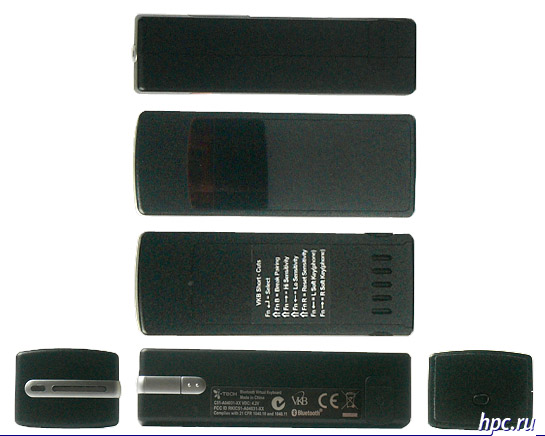
Even the most experienced in the technique of friends, which was presented to housing VKB, could not guess what it is. No wonder - a box comparable in size to a pack of cigarettes (noticeably narrower and slightly thicker thereof), made of soft-touch of dark gray plastic, has a couple of buttons and no moving parts.
I-tech Bluetooth Virtual Keyboard: Science Fiction at your desk
Inscriptions, there are almost no hints, only on the rear panel glued help on special combinations of keys (about them later). In general, the enhancement of mystery. To solve it, you need to install VKB on a flat surface and press the button a couple of seconds on the left side. In this case, flashing blue light in the upper body, and invisible under normal conditions of red rays "draw" on the table clearly visible image of the 63-key keyboard! Comes to mind the many fantastic films, but unlike them, VKB really works, giving you click "virtual keys" to any Bluetooth-compatible device.
    For clarity, offer to get acquainted with the characteristics of the keyboard:
  • Layout: 63 full-size keys, QWERTY and QWERTY
  • Projection Size: 295 x 95 mm
  • Wireless Interface: Bluetooth, version 1.1 class 2 with support for profiles HID and SPP Profile
  • Compatibility: Pocket PC 2002, Windows Mobile 2003/2003 SE/5.0; Palm OS 5.2/OS 5.4; Symbian UIQ, Series 60, and laptops Windows 2000/XP (but it is better to specify a vendor compatibility with specific devices)
  • Operating: works with any standard sources of ambient light brightness to 600 lux (typical office lighting is usually 200-300 lux)
  • Dimensions and weight: 90x34x24 mm, 80 g

Supplied

I-tech Bluetooth Virtual Keyboard: Science Fiction at your desk
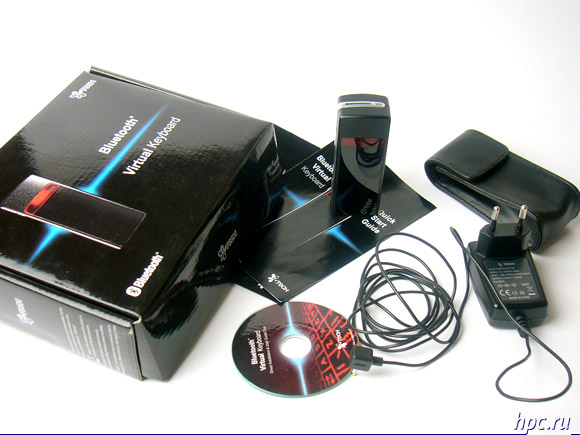
Being an expensive (around $ 250) and quite spectacular accessory, VKB can be a great gift. Contributes to this and a stylish black box, which is supplied accessory. Except for the "cubes" keyboard, the box contains a charger for the built-in lithium battery, carrying case for easy transportation device, made of synthetic leather and a pair of thin bukletikov with instructions and a small CD with drivers for different types of computers.

Operating principle
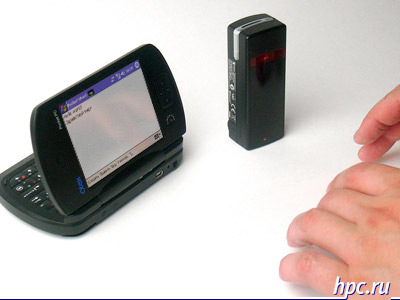
I-tech Bluetooth Virtual Keyboard: Science Fiction at your desk
With the same success you can draw a keyboard on a desk or work blindly ...
In fact, a stylish red keyboard, projected onto the table, we need only to you. In the sense that just as well you can draw it on the table marker or even to work blindly. To your touch to the table top are keystrokes, is the next process. At 1-2 mm from the table, parallel to its surface, working area covers a built-in unit infrared LEDs. Of course, this auxiliary lights the eye is not visible. When you touch a finger of one of the keys, you cross this "illuminated" the plane, infrared rays are reflected from the finger. This reflected light is captured CMOS-sensor installed in the middle of the VKB and after a complicated process, set the coordinates of the finger. Comparing them with the available memory "mesh" keyboard, you can determine what kind of key was pressed. All this is a bit like the usual optical mouse, only in an increasingly technological and impressive form.

Communication with computer

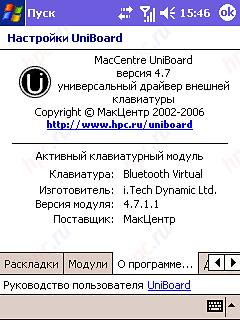
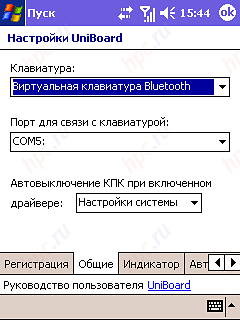
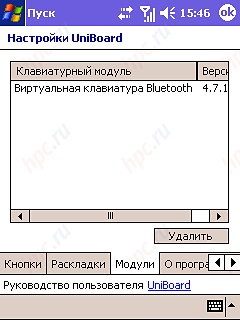
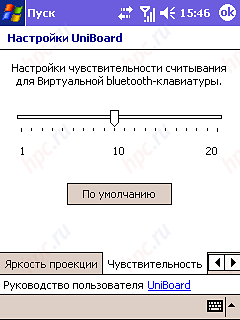
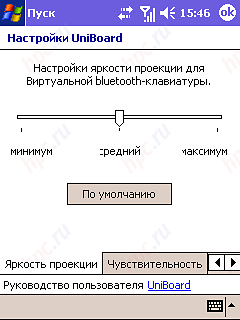
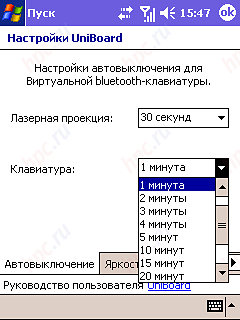
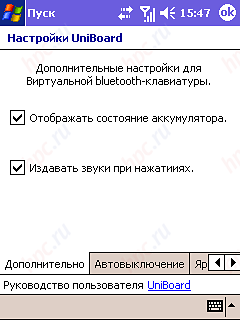
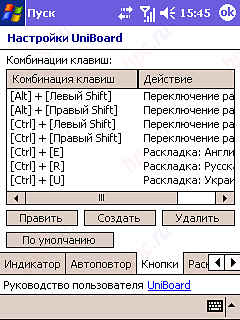
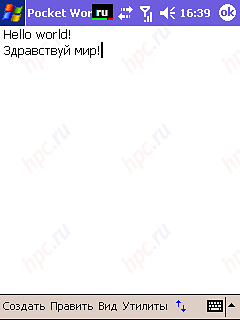
VKB supports two profiles Bluetooth - HID and SPP. First used with notebooks and ordinary computers, whereas the latter is useful for communication with PDAs and smartphones. Accordingly, if your laptop or computer has Bluetooth support and decent drivers are installed, then connect to the computer VKB can be no pulling out of the box "home» CD. However, you can and get it - thanks to our own drivers, you can reconfigure the VKB and assess the status of the keyboard, first of all - the battery level. For Pocket PC is installing drivers is mandatory. Specifically for this keyboard, Mobility development company "MakTsentr" makes a version of its keyboard driver MacCentre UniBoard. In our tests, we used an alpha version of this application, and therefore warned in advance that with the release of the program interface will change somewhat.
I-tech Bluetooth Virtual Keyboard: Science Fiction at your desk
So, in the settings of the driver can, in particular, to adjust the sensitivity of the keyboard that is very relevant point.
I-tech Bluetooth Virtual Keyboard: Science Fiction at your desk
There are also adjust the brightness of the projected image, the auto-mode, etc.
I-tech Bluetooth Virtual Keyboard: Science Fiction at your desk
Among other things, you can configure the unused Fn key combinations to quickly launch applications.
I-tech Bluetooth Virtual Keyboard: Science Fiction at your desk
When you first turn on the keyboard, it often flashes blue to indicate a willingness to "mate" with the computer. Running on a PDA or smartphone search for BT-devices, you will see a list of HID-device «VKB». The pairing on your PDA, you are asked a PIN, you can invent yourself. And now the non-obvious point - for successful mating to quickly enter the same PIN code on the projected keyboard and click on it Enter. After that, the keyboard goes for rare "winks", signaling the normal mode of operation. You can start typing.
I-tech Bluetooth Virtual Keyboard: Science Fiction at your desk
Each time you turn the keyboard it tries to establish communication with the parent of BT-device so when properly set up the last, to get started with the keyboard need not take any additional action.If you need to configure the keyboard to work with another computer, the current registered device can be reset by a half-second by clicking "reset" (hidden in a recess under the lid on the right side), or by pressing a special key combination on the projected keyboard.

The practice of using

Use of VKB is a very interesting exercise, because all feelings are fundamentally different from working on a conventional keyboard. The main and most unpleasant - the lack of tactile feedback. In fact, you drumming on the table, which is to your touch does not react. True, the keyboard produces evidence flicks, and this is a very easy job. And it complicates what is actually pressing detected when the finger still hangs in the air at an altitude of about 1 mm, so that you can type text, even without touching the table.
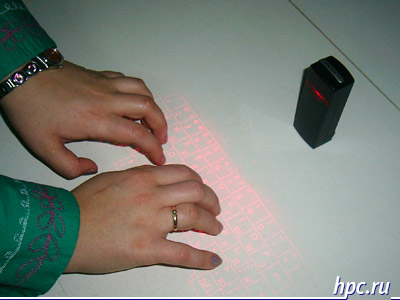
I-tech Bluetooth Virtual Keyboard: Science Fiction at your desk
Get used to this challenge. The main problem - the hand and fingers for a second can not be put on the table for the rest, because while dramatically increasing the percentage of false positives. It is also difficult to get used to that move your finger from the button on the button to far enough "taking" it from the surface, high in the air. In general, the more you have experience in working on a conventional keyboard, the more effectively you are drumming on the usual keys, the more difficult to retrain. When printing blindly most typical mistake - the appearance of extra spaces in the middle of words. When printing with two fingers, there are extra letters when a finger is transferred from one key to another too low. Unfortunately, the manual does not include any advice on the accurate collection, so I would venture to give them away. At first, closely monitor their own hands. See what actions lead to the wrong set and try to avoid them. If some of the letters you typed, did not appear on the screen, you should reduce the sensitivity of the driver settings or by using a special keyboard shortcuts. If you are extra letters, the sensitivity should be increased. Apparently, the developers understand this term as something else than I am - in my understanding it should be vice versa. Advisable to keep your hands in the air, a few inches above the table. If you are typing blindly, especially watch out for "altitude" wrists and thumbs. If you print two or four fingers, each time to lift them straight up at least half a centimeter before moving on to the next key. All of this just sounds complicated, but in fact a couple of days of torment and abuse can be used to this particular style of recruitment, with almost no damage, compared with the usual speed of input, work with VKB efficiently and accurately. At first, doing 5.3 errors per typed line, but after a few days has been falling to more acceptable than 5.2 errors per page. Another important point - the lighting conditions. Depending on these changes as keyboard on the visibility of the table, and the quality of detection keys. In the artificial office or home lighting, with dim daylight, no problem. If, however, sit in a fine day by the window, the keyboard fades. Visibility image can be improved by increasing the intensity of light, this configuration is. But even the highest brightness will not help if your desktop illuminated by direct sunlight. Moreover, under these conditions does not work correctly combination of infrared diode and sensor, thus to determine the keystrokes not impossible - on the keyboard lights up red. In general, for VKB bright illumination of the working place is evil.
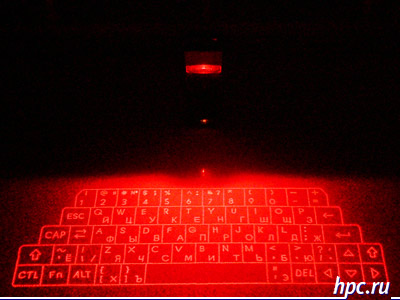
I-tech Bluetooth Virtual Keyboard: Science Fiction at your desk
Another important point when dealing with VKB - the lighting conditions

Runtime

Despite the relative simplicity, VKB is literally crammed with "greedy" components. Transceiver Bluetooth, laser projector, an infrared LED auxiliary - all built-in battery is quickly discharged. During active operation, the manufacturer claims - more than 120 minutes. In reality, it depends on the intensity of the set, the brightness of the projection keyboard, and varies between 90 and 120 minutes. This is much less than the "stretch" your PDA or even a laptop in the office mode, so the figure is clearly too small. The good news is that the active set for a long time need not happen very often. To save battery and has automatic shutdown VKB via a user-specified period of inactivity. To turn the keyboard, simply press the button at the end. And to turn off, just need to detach the case from the table - the sensor on the bottom immediately turn off all the stuffing.

The amount of impressions

The idea behind the VKB, extremely promising. With the advent of more efficient batteries and more compact electronic components can be set as all the same full-sized keyboard is even more petite. And the current version is quite comfortable to carry and fits in any pocket. It allows you to literally 3-5 seconds to deploy sufficiently comfortable and functional workspace to any apprentice table - if only it was flat and empty. The keys will remain at their full size, and their number corresponds to the computer standards. But, unfortunately, VKB is completely useless in an environment where the above-described table is unavailable to you, for example, in the car. In this sense, hard folding keyboards are more effective solution. Also embarrassing inability to work in bright sunlight, for example, on a summer terrace restaurant. Given the ubiquitous Wi-Fi is becoming a noticeable limitation. But most "bottleneck current version is a small battery life. Fully charged battery will not be enough even for half a day of work away from the office. By the strong points of VKB, besides those already mentioned, include high flexibility (suitable for any PDA, smart phones and computers) and reliability (there are practically no moving parts and unreliable contacts). Given the high prices, the most likely audience will be businessmen who want to comfortably edit documents and respond to emails while waiting for her flight at the airport or in another office in the negotiations. Well, of course, do not miss their fans the most advanced technical solutions, because the VKB - is an impressive gadget, and a great way to impress friends and acquaintances. The authors, translation:

Review of "live" Palm Tungsten T. Part One, steel

Review of "live" Palm Tungsten T. Part One, steel
For the past three years I use exclusively by the operating system Palm. I know her well, changed a lot of models for a long time, yes indeed, as much as I waited for the release of new operating systems ... even more devices based on it, look at what else is capable of a legendary company. Recently, the PDA market was a lull. No, no, on the surface of all the bubbling and gurgling: handheld computers came into vogue, companies zhelezyachniki (producers of computer hardware) has finally realized that the CCP is the thing demanded, but the main thing - the fashion and began to flood the market model similar to one another. Well, it is no wonder, operating systems that have proven their loyalty to the user, after the untimely death EPOC remained only two: Pocket PC, so Palm OS. Both, it is not difficult to see very demanding on hardware solutions, and that's filled with endless clones of the shops have already gained success models. To announce the new operating system, Palm has identified certain point out of the vicious circle, that's just in my opinion, too early. Release of the new OS world waited over a year. During this time, the development time to acquire so many rumors, mysteries and guesses that at some point became clear: that Palm would not do it, it will still be worse than what already nafantaziroval currently user. Moreover, the company Sony, apparently recently trying to someone to prove their weight on the PDA market and, therefore, produced several models in the month, the pop-user more and more close to the most rumored model PDA. The undoubted climax of this was, of course, the representation model NR-series. Thus, the debut of a new, in fact, generations of handheld computers Palm, in the face of Palm Tungsten T was held in late October. And only now, before Russia got the first machine that can be touched with his own hands, poke regular stylus, compared with competitors, to assess how the rumors came true.
Review of "live" Palm Tungsten T. Part One, steel
We begin immediately with the specifications. The heart of Palm Tungsten is a processor OMAP1510, from digging Texas Instruments, which consists of two subprocessors: ARM 925 and C55x. The latter - a DSP (digital signal processor) processor and is used exclusively for the implementation of multimedia tasks. Also on the main processor implemented LCD controller, USB, SD, Bluetooth. Despite higher than the previous generation of processors Palm (Motorola Dragonball EZ, VZ) clock, OMAP1510 compare with them in power consumption.
Review of "live" Palm Tungsten T. Part One, steel
Tungsten does not shine in memory: 8 MB Flash, 16 RAM. It's just heartbreaking, because at first glance, the program for the five, on average, one and a half times more unique to version 4.1. Sure is there a slot for cards SD, which can also work with the periphery on the basis of this standard. The display is nothing new in the design is not introduced - such as for a year already shows us Sony: 320 by 320 pixels, 16 bit, the front lights. Pleasant one - Palm has finally officially adopted a new, high resolution and basic "disease" of these handhelds - "dancing pixels obsessive, hopefully, cured.
Review of "live" Palm Tungsten T. Part One, steel
Screen closes a transparent plastic lid with a hole for access to the joystick, which is simple enough anywhere to forget: apart from the Tungsten, it skillfully disguised as details of the interior, so that, at first, I had almost lost her. Then it became clear that the lid can still mounted on the rear panel - convenient, and most importantly, it is clear that someone thought about it. «TT» equipped with a speaker and microphone, and "right off the bat is able to work as a voice recorder - record and play back voice messages. For these purposes, at the end, where the Sony is usually wheel JogDial, made a special button to start recording, and beside it is a hole-in microphone. His way, you can inadvertently hurt when you press the button. Speaker (I mean a real speaker, not the beeper, as in the previous Palm) now adorns the front panel by an elegant mesh. In light of the fact that the speaker is not very loud, it is a pleasant alternative to the standard 3.5 mm headphone jack. Themselves earphones do not like, however, there is no mp3 player. In this connection, go obsessive rumors of imminent withdrawal from the free player of Palm and its analogue on Real Audio.
Review of "live" Palm Tungsten T. Part One, steel
Another pleasant surprise was the use of a Palm Tungsten universal connector (Universal Connector), so that most of the periphery of m500 series can be perfectly used with «TT». This, incidentally, it becomes clear immediately: the new set of standard cradle 500y series with the same standard power adapter. A useful "frills" can also be noted LED indication of charging batteries and alarm, vibration, and, of course, rapidly entering the mode Bluetooth.
Review of "live" Palm Tungsten T. Part One, steel
Deserves special attention stylus. Telescopic metal pen kept on a special mount and gets a touch on the tip. For dealing with clear analogy is a comparison with first-class PDA stylus Newton series 130 and 2000. Separately to say about the buttons and controls. Of course the main "chip" is a sliding area of ​​graffiti. The idea is very good, but certainly not original (think, for example, Sharp Zaurus, with its sliding keyboard). Most interestingly, it is this innovation and bring the greatest amount of frustration. For example, if a closed area graffiti remain closed part of the action buttons, including back button in the main menu (house) and the context menu. As a result, in the folded state can not even call a soft keyboard! The most offensive that these functions can not even give any of the 4 hardware buttons, joystick, neighbors, have all the time to open and close a PDA. There is in this opening and closing and interesting solutions, for example, you can make your computer turned on when you open the graffiti on and off at closing.
Part One, steel "width =" 213 "height =" 300 "/>
Joystick, in my opinion, is the most useful acquisition, especially in light of future multimedia capabilities, in particular, advanced games, which these same opportunities will be used. In our daily work life, he was really helpful to me except that only when working with spreadsheets. The power button is on top, next to her the elegant svetodiodik slightly get on the front panel. Infrared, as well as it lives on top, and is represented by a narrow dark little window next to the card slot.
Review of "live" Palm Tungsten T. Part One, steel
I would say that design new Palm I rather like it than dislike. Despite the fact that in the folded position, he looks a bit kutsym, but it fits easily into a shirt pocket, for some reason considered to be the benchmark for small size, and, in general, in any pocket of your choice. Brushed metal case, in conjunction with black plastic gives you a feeling of solidity and strength of the assembly as a whole, like the good old Palm Vx. Well, of course, a wonderful stylus that completes the image of an expensive and stylish things. The authors, translation: